


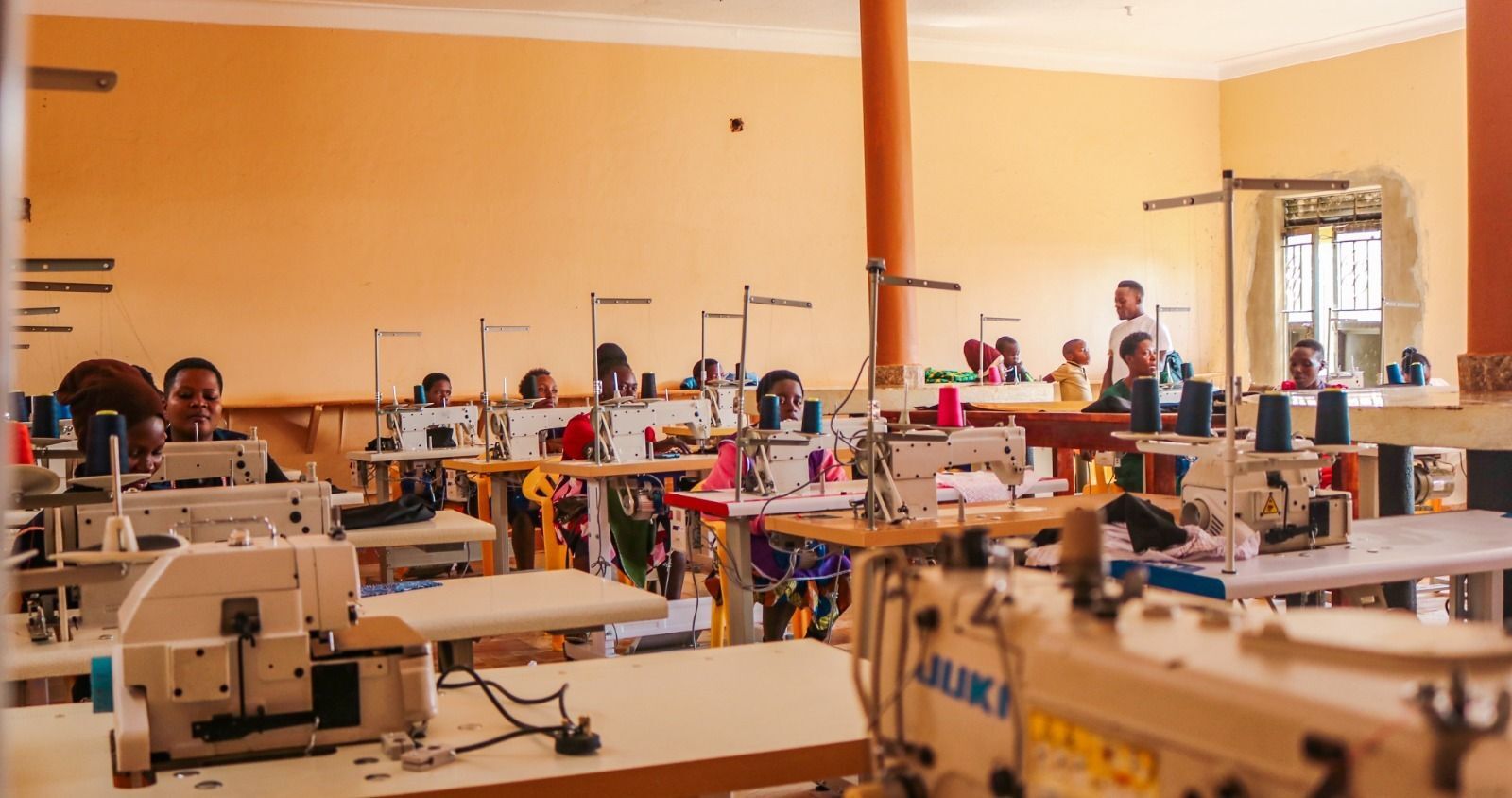
In Nakaseke Town Council, a quiet but powerful shift is underway—one that moves beyond training and directly into income generation.Through a strategic partnership between the Rose Namayanja Foundation (RNF) and the Uganda Industrial Research Institute (UIRI), a fully equipped Textile Skills Development and Production Centre has been established to turn local potential into a productive enterprise.
Why This Centre Matters
Across Uganda, thousands of young people and women possess informal skills but remain locked out of meaningful income due to a lack of tools, structured training, and access to markets.This centre directly addresses that gap by combining:
- Hands-on industrial training
- Access to modern production equipment
- A pathway to entrepreneurship and job creation
The result is simple: skills that translate into income, not certificates that gather dust.
Built for Production, Not Just Training
Unlike conventional vocational programmes, the Nakaseke centre operates as a live production hub.Equipped with industrial-grade machinery installed by UIRI, the facility can produce up to 2,000 garments within a single eight-hour shift. Trainees are immersed in a real manufacturing environment, gaining practical experience that prepares them for immediate entry into the market.This approach ensures that participants do not just learn—they produce, earn, and grow.“Our focus is to ensure that women and youth—who are the backbone of our communities—can convert their skills into sustainable income,” said Rose Namayanja Nsereko, Director at RNF.
Closing the Gap Between Training and Livelihoods
Traditional vocational systems often stop at certification. This model goes further.According to Prof. Charles Kwesiga, Executive Director of UIRI:“This initiative is designed to bridge the gap between training and production. It is about enabling individuals to build sustainable livelihoods and become entrepreneurs, not just graduates.”By integrating training with production capacity, the centre creates a direct pipeline from learning to earning.
Local Impact Already Taking Shape
For local entrepreneurs, the centre represents more than opportunity—it represents scale.Milly Nakafeero, a textile business owner in Nakaseke, sees immediate potential:“This training will help us improve quality, increase production, and compete for larger opportunities like supplying school uniforms and institutional contracts.”This is how local economies grow, not through theory, but through production capacity and market access.
Open, Inclusive, and Accessible
One of the centre’s most transformative aspects is its accessibility.Enrollment is open to all, regardless of academic background. What matters is the willingness to learn and commitment to work.This removes a major barrier that has historically excluded many capable individuals from economic participation.
Get Involved
Whether you are a young person seeking opportunity, a local entrepreneur looking to scale, or a partner interested in expanding this model, the door is open.Visit the Textile Skills Development and Production Centre in Nakaseke Town Council to learn more about enrollment and partnership opportunities.
